
A ticket goes on sale. Within minutes, you’re not just buying seats. You’re booking a trip. The destination wasn’t on your list. But now you’ve committed to going, so everything else gets built around that one event.
That’s an event-cation: travel where the experience comes first and the logistics follow. Sporting events, concerts, cultural celebrations, and food and drink festivals are the anchors modern travelers book entire trips around. And for most, the event is just the starting point: 88% plan to layer in dining, shopping, or sightseeing around it.
You’d expect this kind of travel to be expensive and impulsive. And it can be. But the reality, based on more than 1,000 travelers surveyed by Vogo, is more strategic than that, much like how travelers approach shorter getaways. Most are keeping total spend under $1,000 per person. They’re saving deliberately, making trade-offs, and building bigger vacations around a main event — not just showing up and hoping for the best.
Coachella draws the same wave of event-cation planners every spring, and the FIFA World Cup, which is spread across North American host cities over the summer, is often one of the biggest single drivers of event travel. For anyone planning to attend events like these, the decisions made in advance will determine whether the trip delivers or disappoints.
Here’s what the data shows about how travelers are handling costs, and which choices, especially around lodging, give you the most room to maneuver.
For 70% of Event-Cation Travelers, the Budget Is Already Figured Out
41% of the event-cation travelers we surveyed have budgeted carefully and feel prepared to spend accordingly, while 29% aren’t worried about cost at all. They’re going for the experience, at any price. Together, that’s 7 in 10 travelers who’ve already made their peace with what this trip will cost.
Only 13% are taking active cost-cutting measures because it’s the only way they can afford to go. The dominant mood heading into these trips is preparedness, not panic.
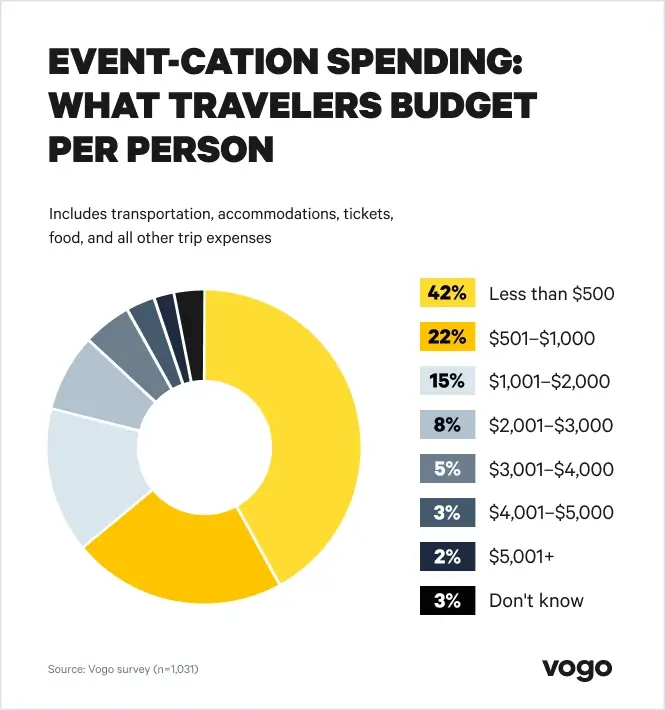
Nearly two in three (65%) respondents plan to keep their total per-person spend under $1,000, with the largest group (42%) expecting to spend less than $500. That’s across all expenses: the event itself, transportation, lodging, food, and everything in between — the same categories that shape any vacation cost estimate.
Event-cations, it turns out, are one of the more deliberately managed forms of travel. People are adjusting budgets and making trade-offs to say yes to one thing they’ve decided matters.
The Real Price Shock Isn’t the Hotel, It’s the Hot Dog
The conventional wisdom around event travel is to watch out for surge pricing on flights and hotels near the venue. The data disagrees.
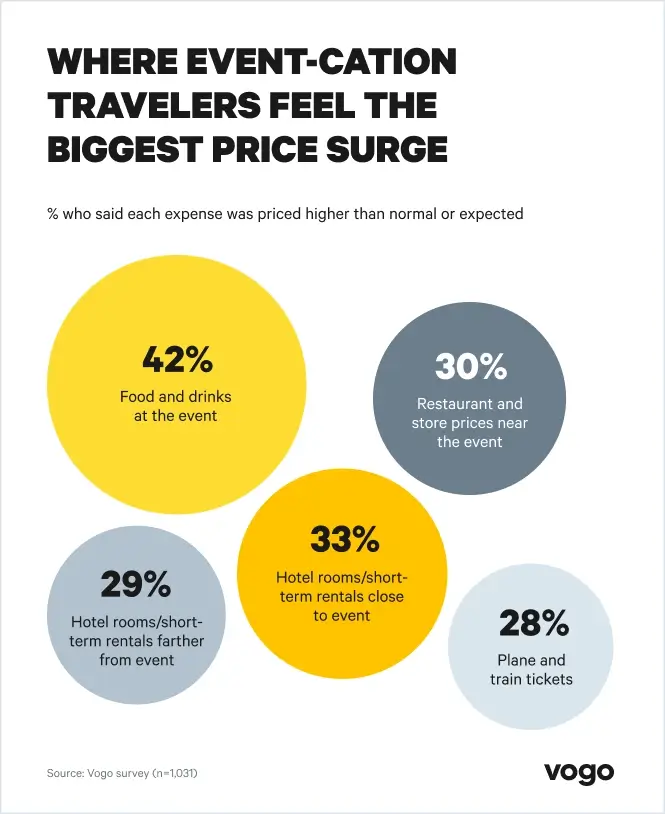
Food and drinks at the event itself came out on top (42%) by a wide margin. Flights, nearby hotels, and restaurants all ranked lower. Travelers spend months preparing for the logistical costs of getting there and staying somewhere, only to arrive at the venue to find an unexpected markup at the concession stand.
The problem is that on-site food and drink costs aren’t negotiable. But if on-site costs are largely fixed, lodging is the most logical place to find flexibility. Staying a few miles out instead of closest in, or splitting a short-term rental with a group, can offset a lot of what the concession stand will take from you later.
From Side Hustles to Road Trips: How Travelers Fund Their Event-Cations
The strategies people use to afford these trips range wider than you’d expect. And some of them signal just how committed travelers are before even packing a bag.
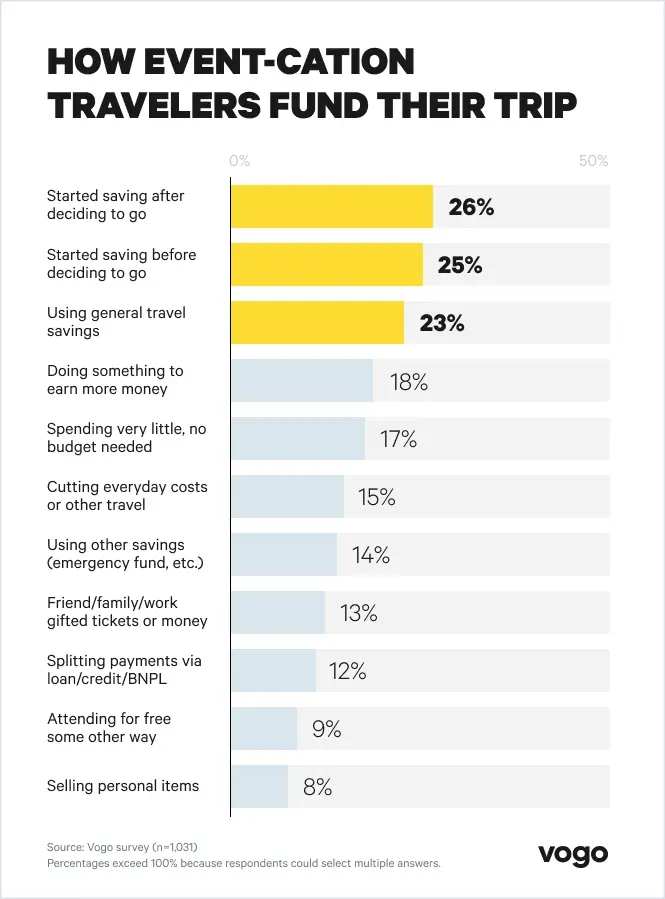
Most are drawing from savings in some form, whether that’s money they started setting aside after committing to go (26%), a general travel fund they maintain year-round (23%), or cash they were quietly setting aside before they’d even officially decided (25%).
For those who haven’t financially prepared, there’s always a way — even if that means financing the trip and sorting out the rest afterward.
Getting to the event is one challenge. Staying under budget once you arrive is another.
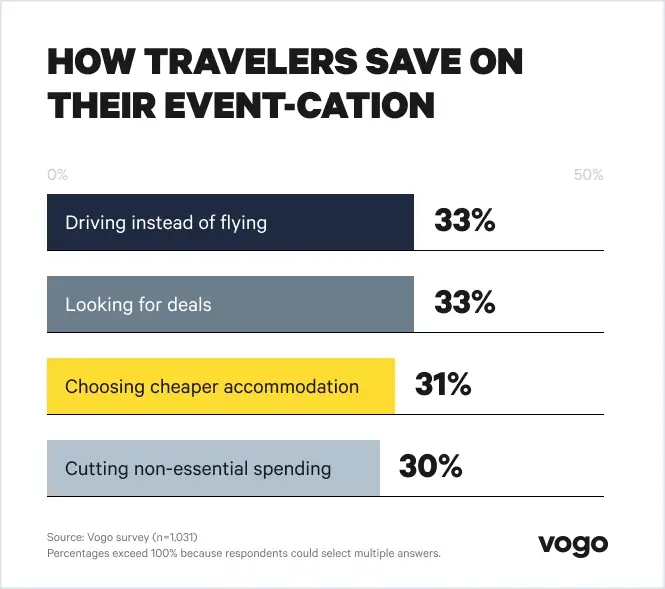
Driving instead of flying and actively hunting for deals through apps or price tracking were the top two savings strategies, each chosen by roughly a third of travelers, though high parking costs can narrow the driving advantage more than people expect. Almost one in five (18%) cut other vacations entirely to afford the rising cost of the trip, a sacrifice that shows how much they matter once someone commits.
The Sweet Spot for Booking Event Travel Is 1 to 6 Months Out
44% of travelers decided to attend their event one to three months beforehand, with another 27% committing four to six months out. Only 17% decided less than a month before the event.
That one-to-six-month stretch is when people have the most flexibility. Travelers who wait until tickets are in hand often find that nearby accommodations are already sold out or priced up.
Locking in lodging early, even before the full itinerary is mapped, leaves more options open and more price points to compare. Rates shift as the date approaches, and availability that looked gone weeks earlier sometimes opens back up through cancellations.
When asked to prioritize price vs. convenience, the responses split almost evenly. 33% of travelers prioritize convenience (like being close to the venue), 31% prioritize price, and 33% say both matter equally. There’s no universal right answer. It comes down to what you value most and whether you’ve thought about that honestly before you start searching.
The One Thing Travelers Can Still Control When Event Prices Surge
Event-cations don’t have to be the chaotic, budget-blowing trips they’re often made out to be. People are adjusting and making deliberate trade-offs to say yes to what they really want to do.
On-site costs are fixed. The data shows travelers already know this. This makes lodging choices the most practical way to find flexibility in a budget. Our guide to cheap places to travel can also help identify destinations that offer the most room to work with. Staying a few miles from the venue, splitting a short-term rental with a group, and booking within that one to six-month window are decisions that can make the rest of the trip work.
On Vogo, you can filter by distance from a venue and compare hotel and short-term rental prices side by side — so the trade-off between proximity and cost is visible before you commit, not after.
Methodology
This study was designed and conducted by Vogo as part of our ongoing research into travel trends. Vogo engaged Centiment to assist with survey administration. The survey was fielded between April 1–2, 2026. The results are based on 1,031 completed surveys. To qualify, respondents were screened to be residents of the United States, over 18 years of age, and planning to travel more than 25 miles in the next 12 months to attend a specific event (sporting event, music festival, cultural event, etc.). Data is unweighted, and the margin of error is approximately ±3% for the overall sample with a 95% confidence level.
Fair Use Statement
We welcome others to share our findings and graphics, provided they attribute the work to Vogo and link back to this page.